Encounter with the barometer salesman
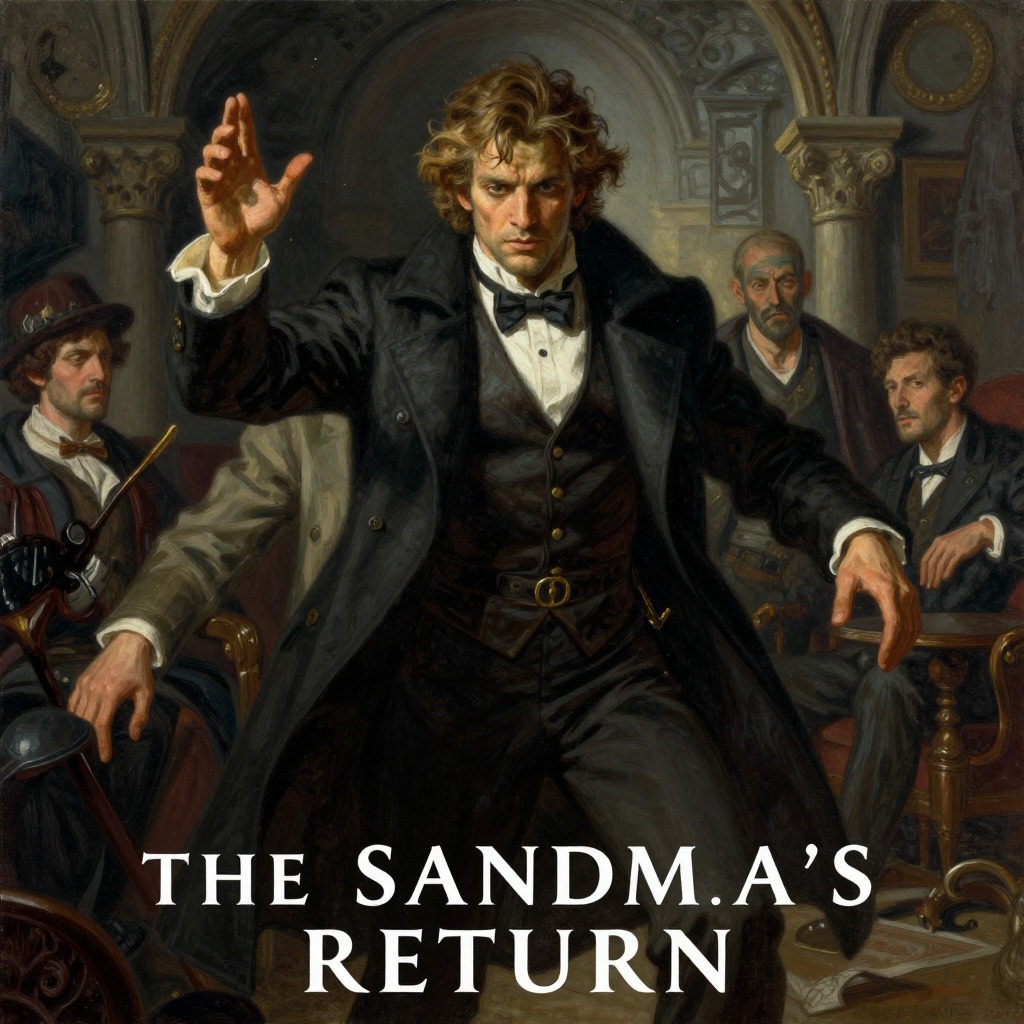
On 30 October, at twelve noon, a barometer salesman stepped into Nathaniel's room and offered him his wares. Nathaniel bought nothing and threatened to throw him down the stairs, whereupon the salesman left of his own accord. This apparently mundane occurrence, however, had a devastating effect on Nathaniel's life, as he confesses in a letter to his friend Lothar. The salesman was none other than the accursed Coppelius, the man Nathaniel holds responsible for his father's death. Though Coppelius was now dressed differently and called himself Giuseppe Coppola, a Piedmontese mechanic, his physique and facial features were too deeply engraved in Nathaniel's memory for him to mistake him for another. The reappearance of this figure, whom Nathaniel had not seen since the night of his father's death, struck him as a sign of bad things to come and resolved him to confront Coppelius and avenge his father's death, come what will.
Childhood Origins of Terror
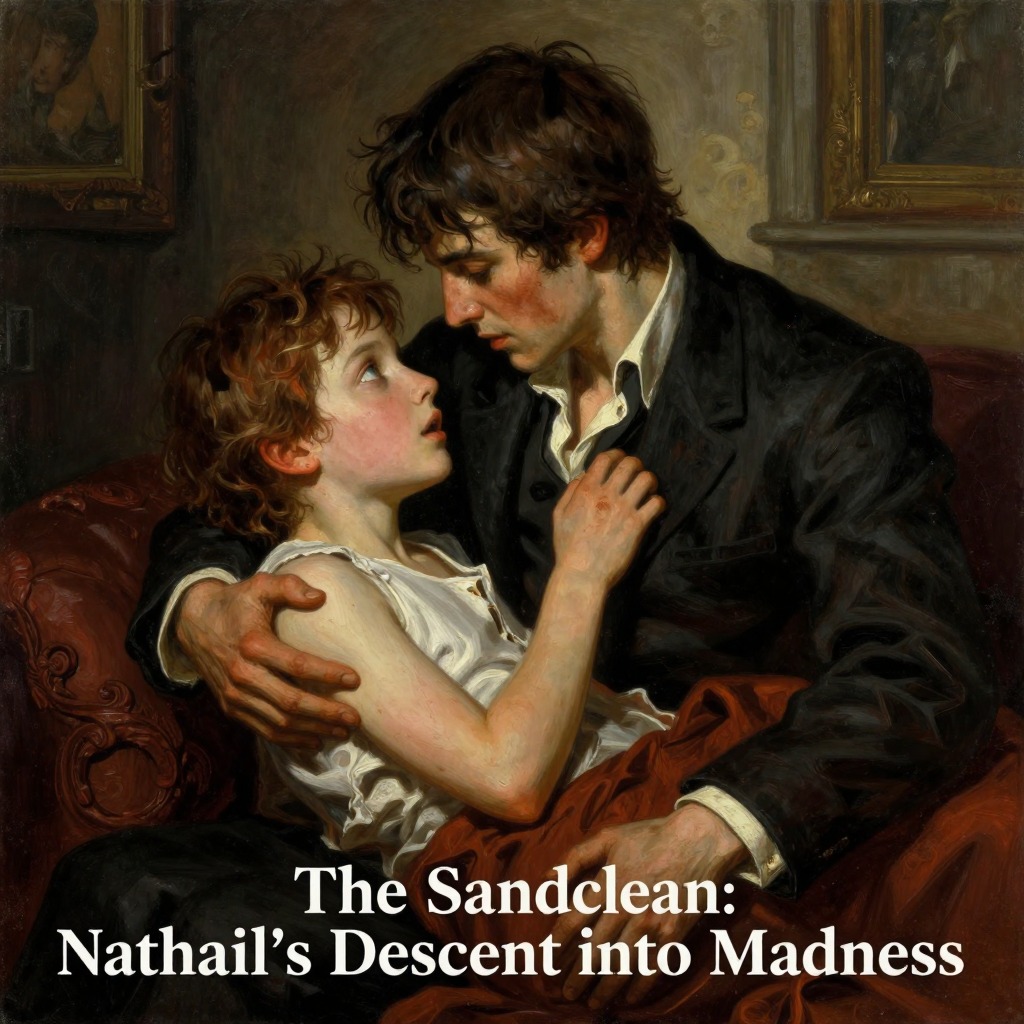
The barometer salesman's visit reactivated a terror that had its roots in Nathaniel's childhood. As a boy, Nathaniel had been terrified by the nursery tale of the Sandman, a bad man who flings sand in children's eyes, then carries them off to the half-moon to feed his children, who pick out the eyes of naughty human brats with their crooked beaks. This figure became entrenched in Nathaniel's mind as a hair-raising spook, and he was gripped by dread and terror when he heard him come clambering up the stairs to his father's study. Driven by an overpowering urge to see the fabled Sandman, Nathaniel hid in his father's room and discovered that the Sandman was the old barrister Coppelius, a hideous, ghastly fiend with a misshapen head, ochre-coloured face, and piercing greenish cat's eyes. Coppelius, together with Nathaniel's father, conducted secret alchemical experiments in a hidden hearth, and when Nathaniel was discovered, Coppelius grabbed him, hurled him at the hearth, and threatened to strew glowing cinders in his eyes. Nathaniel's father pleaded for his son's eyes, and Coppelius instead twisted off the boy's hands and feet before reinserting them. This traumatic event left Nathaniel with a high fever and a lifelong horror of Coppelius.
The Father's Death and Coppelius's Disappearance
About a year after the childhood encounter, Coppelius returned to the family home. Nathaniel's mother, going pale, recognized his step, and his father, with a weak and broken voice, confirmed it was Coppelius, promising it would be the last time. That night, a terrible boom like a cannon shot went off, and Nathaniel rushed to his father's room to find him dead on the floor, his face burnt black, with his mother lying unconscious at his side. Nathaniel cried out, "Coppelius, you cursed Satan, you killed my father!" before losing consciousness. The explosion awakened the neighbors, and the authorities issued a warrant for Coppelius's arrest, but he had disappeared without a trace. This event cemented in Nathaniel's mind the conviction that Coppelius was a devilish force responsible for his father's death.
The Reappearance and Its Consequences
When the barometer salesman, whom Nathaniel immediately recognized as Coppelius under the name Giuseppe Coppola, appeared in his room, the trauma of the past was violently reawakened. Nathaniel's letter to Lothar describes the event as a terrible thing whose fatal impression he tried in vain to erase from his consciousness. He resolved to confront Coppelius and avenge his father's death. This resolution, however, does not lead to a direct confrontation. Instead, the encounter sets in motion a chain of events that leads Nathaniel to purchase a looking-glass from Coppola, through which he first sees Olympia, Spalanzani's daughter, and becomes obsessed with her. The looking-glass, which brings distant objects into sharp focus, reveals Olympia's face to Nathaniel in a way that makes her eyes seem to flash open in moist moonbeams, and he becomes transfixed. This obsession ultimately leads to the revelation that Olympia is an automaton, a lifeless doll, and to Nathaniel's descent into madness. The barometer salesman, therefore, is not merely a peddler but the catalyst for the story's central tragedy, the figure who reopens the wound of Nathaniel's childhood and drives him toward his final, fatal confrontation with the uncanny.